Electrical Cooling Solutions have developed a series of custom thermal simulations tools, specifically configured for electrical machines and power electronics systems.
We have developed our toolset and workflow to allow the accuracy and detailed insight of CFD to be utilised without the need for expensive commercial software or time-consuming user input. We aim to facilitate a quicker process towards optimised designs, giving significant competitive advantage over non-specialised thermal design processes.
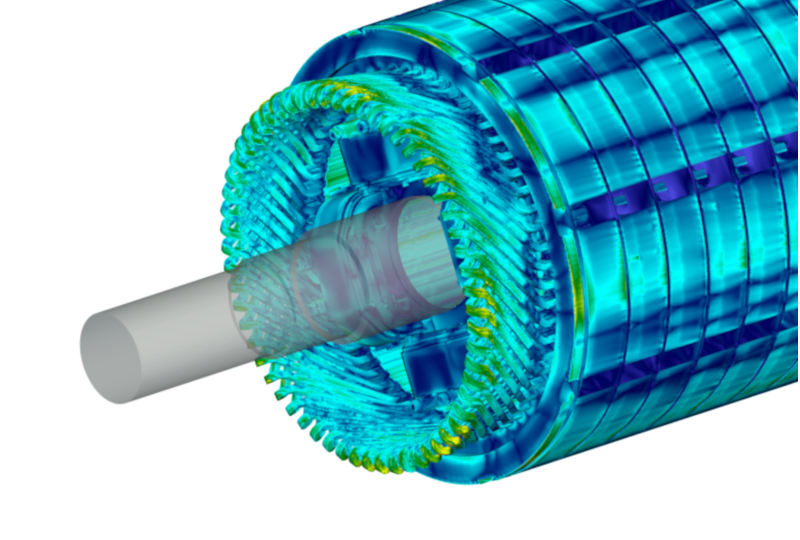
Motivated to improve the speed and cost effectiveness of CFD modelling for electrical machine design, we have developed a CFD process using OpenFOAM tailored for electrical machines. This process provides a great level of automation, whilst maintaining full control.
CFD data links to a fully flexible and detailed thermal network suite, allowing quick and accurate temperature predictions to be made. This facilitates an improved optimisation process of system parameters.
Customised OpenFOAM CFD toolset, tailored for electrical machines and electronics
Improved speed: minimised setup time – simple CAD input and mesh settings
Robust meshing: rarely requires mesh regeneration to improve cell quality
Affordable: No expensive commercial licenses – costs don't scale up with computing power
Greater automation: Customised workflow for electrical machines; reduced user input; parameterised analysis
Thermal modelling using our in-house thermal network tool
High speed design exploration to expedite the route towards design optimisation
Flexible: able to simulate conventional and novel machines, as well as incorporate innovative thermal management systems
In-built library of correlations for predicting flow and loss behaviour
Coupling between tools
Feed reduced order flow models from CFD into thermal networks
Improved accuracy boundary conditions versus packages that rely on broad empirical correlations
Ability to couple to wide range of thermal modelling packages including commercial codes
Why OpenFOAM
Our CFD process is based around the OpenFOAM (Open Field Operation and Manipulation) CFD Toolbox
Advantages of OpenFOAM:
100% Free
Technologically competitive with all commercial solutions
Full access to source codes and allows for tailored solutions
Accurate results and in many cases faster turnaround times than commercial options
Fully automated processes easily achieved through simple scripting
Ability to rapidly test geometry and boundary condition parameters for time and cost-effective optimisation of a very wide range of problems
Hardware can be effectively scaled with no additional licensing costs